In Sapa, Vietnam

In Sapa, Vietnam

About Me

My photo
Sharing time between Southampton and Noyal-Muzillac in southern Brittany. Sports coach, gardener, hockey player, cyclist and traveller. I studied an MA in Management and Organisational Dynamics at Essex University in 2016-17. Formerly an Operations Manager with NEC Technologies (UK) Ltd.

Friday, 30 January 2015

MOOC Done

Walking today:     3.7km.   Walking MTD: 83.7km.      Walking YTD: 83.7km
Swimming today: 1.35km.  Swimming MTD: 9.05km. Swimming YTD: 9.05km


I finished the OpenLearn MOOC last night, to remind you it was called "In the Night Sky: Orion"

As the first time I've done any proper study for a long time it was a good place to start, a subject I'd covered at University and had an interest in since then. I probably knew about 50% of the course content and the rest comprised some new material and some updates of things I had learnt previously but have changed since (astro-physics is a fast-moving field).

There's no qualification or exams but there was an informal end of course test, I got 29 out of 30 (forgot what happens to a white dwarf at the end of its life - answers by email please).

The Orion Nebula - birthplace of stars


I've signed onto a couple more MOOCs starting later in the year; Cyber Security and Hadrian's Wall. That's quite a broad range of interests .....

Thursday, 29 January 2015

How many men does it take to plant a tree?

Walking today: 3.8km

I've written before about the Amenagement Fonciere - the land re-organisation in the commune that aims to deal with the consequences of the Napoleonic succession laws - and the full report and proposals were published nearly three years ago. As well as reorganising land parcels (we bought a chaotic bundle of ten separate plots in 2009 including three that split the house and barn between different plots) it also allowed land owners to remove certain hedges and talus to make field sizes more logical and specified new voies rurales and new talus to be planted and created at the cost of the commune.

Understandably the farmers enthusiastically pulled down the hedgerows as soon as they were allowed to, the rural roads were installed by contractors last summer and the new planting was scheduled for last autumn.

We knew that a new talus was specified to be planted along the small stream line that runs across Dominique's field at the bottom of our land, the stream is about 30 metres from our boundary. A couple of weeks ago the contractors came to see me to check on access to the field, I re-directed them towards Dominique and a couple of days later a mini digger arrived and proceeded to dig a series of holes along the stream line - this took all day.

Then last week Dominique came to see me to say that the contractor had found it was difficult to plant in the specified position (unsurprisingly it seems the holes had filled up with water) and wanted to know if we would object if the planting was moved up to our boundary. Well yes, actually we would, the open view to the south across three fields was one of the things that attracted us to La Basse Cour and really we'd prefer it if the new planting wasn't done at all.

Yesterday I was working in the garden when I noticed a group of people in wellingtons peering into the holes. There were seven of them and I found Dominique afterwards to find out what had been going on. The men (they were all men) were the contractor, his foreman, the géometre who had managed the Amenagement, a representative from the water company, three members of the local council and Dominique - eight people.

Dominique said that they had realised that the planting was in a zone humide (a river catchment area for the lake where the local water supply is drawn from). How that was overlooked for 3 years after the plan was published I don't know, Dominique said it didn't prevent the planting but made it much more difficult and that alternative positions on his land, or maybe no talus at all had been discussed. I've partly modelled my developing Gallic shrug on Dominique's - the one he gave when I asked when the work would be done showed me how much more work I still have to do ;o)

So, how many men to plant a tree? Eight, but of course as we are in France the tree may not get planted at all.

Wednesday, 28 January 2015

Shock News Story - It's Winter

Walking Today:  3.7km

Where were you on 12th November last year?

Did you read the Daily Express on that day with it's unique take on weather science?

If you missed it the headline was:

POLAR VORTEX WARNING: Latest winter weather models show UK faces MONTHS of heavy snow


Well, maybe I missed something, perhaps I've missed the MONTHS of heavy snow ..... or maybe it's just another example of cheap shock-horror journalism and bad science.

When we bought La Basse Cour Nicolas, the sales agent, said "The climate's nice here, it never snows. Well, not often". 

So it was somehow appropriate that after the sale had gone through we had to battle through snow-covered Normandie on back roads (thanks only to the CRV's four-wheel drive) to collect the keys from Nicolas.

It snowed here in 2010, 2011 and 2012. The winters of 2012/3 and 2013/4 were wet and very wet respectively, Gérard put our roof on in temperatures of -8C in 2012 but said it was much, much worse in 1984 when he couldn't work for nearly three weeks - and if you've met Gérard you'll know what an anathema that would be to him.

In the summer it's lovely here but we do have winter weather. It catches out people who come here in the summer, love the area, buy a house and are shocked to find that, not only is there a winter here, almost everything shuts down and the locals disappear into their thick walled houses for whole weeks.

Fortunately we've had - and still have - too much work to do to be put off by a bit of weather. 

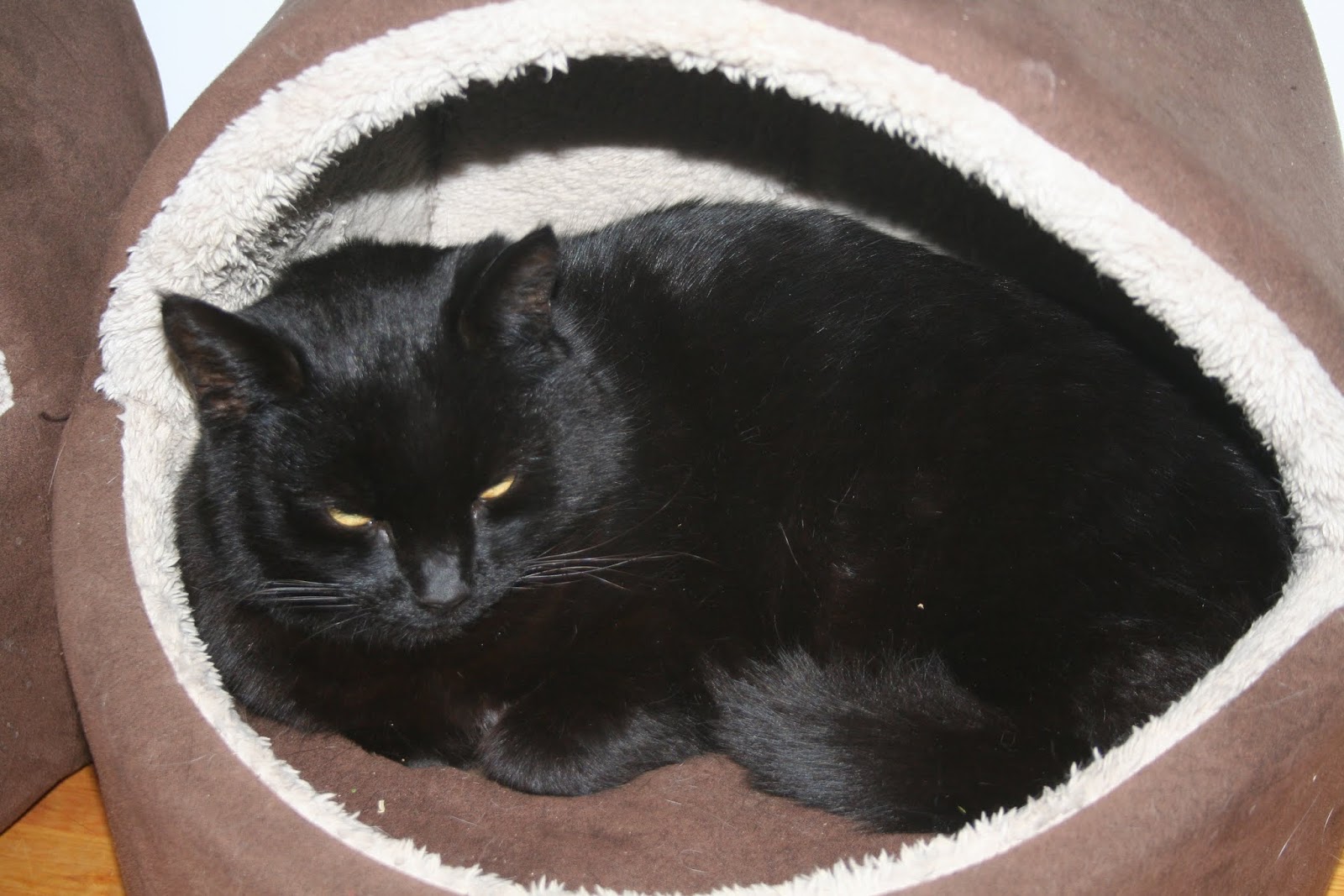
The cats however get increasingly difficult to find unless you know the warmest places (do cats have inbuilt Infra-Red detectors .... ?). So today when a murky morning gave way to a cold, wet and windy day Jess


and Pip 


headed for their favourite spots next to the Logburners.

Tuesday, 27 January 2015

From our Correspondants

Walking Today:     3.8km
Swimming Today: 1.25km

The blog post today is derived from recent correspondence (or at least emails) from readers and an update or two on previous posts.

It's been pointed out that talus (pronounced "Tal-oose" - at least around here) is a term for a medieval castle defence fortification. It's a sloping wall at the base of a castle curtain wall, similar in angle of course to the slope on our talus at the back of La Basse Cour. Maybe not a surprise as much of military defence architecture originated in France and was then transported to England by Guillaume Le Conquerant and his descendents or to southern Europe via the crusades.

The picture of the Moon I posted has taken on a life of its own in the Twittersphere via the #FLOrion15 hashtag of the MOOC I am taking. It's still being quoted, re-tweeted and favorited and was mentioned in the week four course email from Professor Grady, I've gained a few more followers too (still trying to work out who Lolo2003 is though .....).

Charlie is an elegant horse but he's now been moved from the field next to us - Pip has lost his friend and has unfortunately, on the rebound, taken to fighting other cats up trees.

And the chainsaw has responded to its busy January by breaking its brake band, so it is back at Mecadom (the mechanics) just two weeks after being serviced. Hmmmm When I took it in today there were two gendarme cars outside, there were three police inside investigating the theft of a Voiture Sans Permis (VSP) from the compound. For UK readers a VSP is one of those ridiculously small two cylinder, two seat cars, very slow "cars" that can be driven legally without a full driving licence. Can't think the thieves got very far or very fast in that!

Monday, 26 January 2015

A Treatise on the Noble Art of Coppicing

Walking today: 3.7km

Coppicing, the practice of cutting trees down to the ground every 5 - 20 years and harvesting them like a crop, is a very old technique. Some coppiced trees in ancient woodlands are thought to be many hundreds of years old as the process of coppicing keeps the tree young and means that they never die of old age.

The greenwood that Robin Hood knew was most probably managed by coppicing, often using a system called "Coppice and Standard" where isolated high trees are left to grow to maturity to be cut down for constructional timber.

The most usual trees to be coppiced are hazel, oak, chestnut and ash on a cycle from 7 to 15 years depending on the variety and the products required. Most of the trees around the boundary of La Basse Cour hadn't had much attention for a long time before we arrived. We've used professional climbing tree surgeons to tackle the big jobs but everything else has been "fait maison". 

The before picture - the large hazel in the middle is the key tree on this part of the talus


About half way through the work, there are six main stems left at this stage

A cold day, a pile of brash and Barbara in a swiss hat

More of the top growth for eventual burning for ash

Nearly finished - just three main stems left and the "stool" has been cut back to ground level

22 rings so this was a new shoot in 1993 - we were all much younger then ;o)

Final view - exceptionally we left three large poles on this hazel for future harvesting

And Pip came along to help with the work - well sort of

In earlier times the wood would have been used for fuel and the poles burnt for charcoal (a critical ingredient in metal smelting and founding), bark would have been used for tanning animal skins and the finer top growth bundled into faggots to be used as winter fuel by the poorest people.

All the hazels and some of the chestnut, cherry and oak we have are being coppiced; the largest timber has gone to be cut into firewood, we've cut nearly a hundred poles for gardening and construction use, there's a huge bundle of pea sticks for the peas and the rest of the fine growth - brash - has been burnt and we'll use the ash (which is high in potash) in the compost heap and on the garden. We could be even more efficient if we had a high-capacity chipper (expensive) to shred all the finer growth and this could then be used for burning (if we had a special boiler - also expensive ...).

Trees are a carbon-neutral energy source (the carbon liberated in the burning process was originally fixed by the tree from the atmosphere), we probably don't have enough woodland to be fully self-sufficient in wood for energy but the timber we've cut down this week will not probably get burnt until the winter of 2017-8 and next winter we have more major work planned on the remaining mature trees that haven't been worked on so that wood should take us through to 2020. By which time we'll be ready to start harvesting some of the wood from the trees we've coppiced this winter - the symmetry of this whole cycle really attracts me


Sunday, 25 January 2015

Le Comptage des Oiseaux des Jardins - Garden Bird Survey 2015


In Brittany, as in the UK, this weekend has seen the 2015 Garden Bird survey being carried out. We took part this year (from the comfort of the barn behind the glass) and it was useful for us as we've had to learn a lot of vocabulary for French bird names.

So, here's our list from 17:00 - 18:00 today, in French and English:

French Name Number Seen English Name
Troglodyte Mignon          1 Wren
Sittelle Torchepot          2 Nuthatch
Mésonge Bleu          6 Blue Tit
Mésonge Charbonnier          5 Great Tit
Merle Noir          4 Blackbird
Pigeon Ramier          1 Pigeon
Rougegorge Familier          1 Robin
Pinson Des Arbres          2 Chaffinch
Verdier d'Europe          2 Greenfinch
Etourneau sensonnet          6 Starling
Moineau Domestique          1 House Sparrow


Saturday, 24 January 2015

Breaking News


The daily paper with the largest circulation in France is not Le Monde, nor Le Figaro but Ouest France. Managing at the same time to report international news as well as local commune events (on the billboard in Noyal-Muzillac at present is bingo organised by the Basketball Club) it sometimes manages to transpose the sublime with the fairly odd.


So, on the day that Mario Draghi finally committed the ECB to implement Quantitative Easing, Ouest France didn't quite see that as the most important news item:


Well done Margriet!