In Sapa, Vietnam

In Sapa, Vietnam

About Me

My photo
Sharing time between Southampton and Noyal-Muzillac in southern Brittany. Sports coach, gardener, hockey player, cyclist and traveller. I studied an MA in Management and Organisational Dynamics at Essex University in 2016-17. Formerly an Operations Manager with NEC Technologies (UK) Ltd.

Tuesday, 12 December 2017

Pictures in the Imagination

Thomas Nicoll Hepburn (1861–1930) writing under his pseudonym Gabriel Setoun authored the following poem beautifully describing the tracery of frost left on the Velux windows at La Basse Cour this morning as the outside temperature plunged to -3C.


Jack Frost

The door was shut, as doors should be,
 Before you went to bed last night;
Yet Jack Frost has got in, you see,
 And left your window silver white.

He must have waited till you slept;
 And not a single word he spoke,
But pencilled o’er the panes and crept
 Away again before you woke.

And now you cannot see the hills
 Nor fields that stretch beyond the lane;
But there are fairer things than these
 His fingers traced on every pane.

Rocks and castles towering high;
 Hills and dales, and streams and fields;
And knights in armour riding by,
 With nodding plumes and shining shields.

And here are little boats, and there
 Big ships with sails spread to the breeze;
And yonder, palm trees waving fair
 On islands set in silver seas,

And butterflies with gauzy wings;
 And herds of cows and flocks of sheep;
And fruit and flowers and all the things
 You see when you are sound asleep.

For, creeping softly underneath
 The door when all the lights are out,
Jack Frost takes every breath you breathe,
 And knows the things you think about.

He paints them on the window-pane
 In fairy lines with frozen steam;
And when you wake you see again
 The lovely things you saw in dream.


Tuesday, 28 November 2017

Frosty

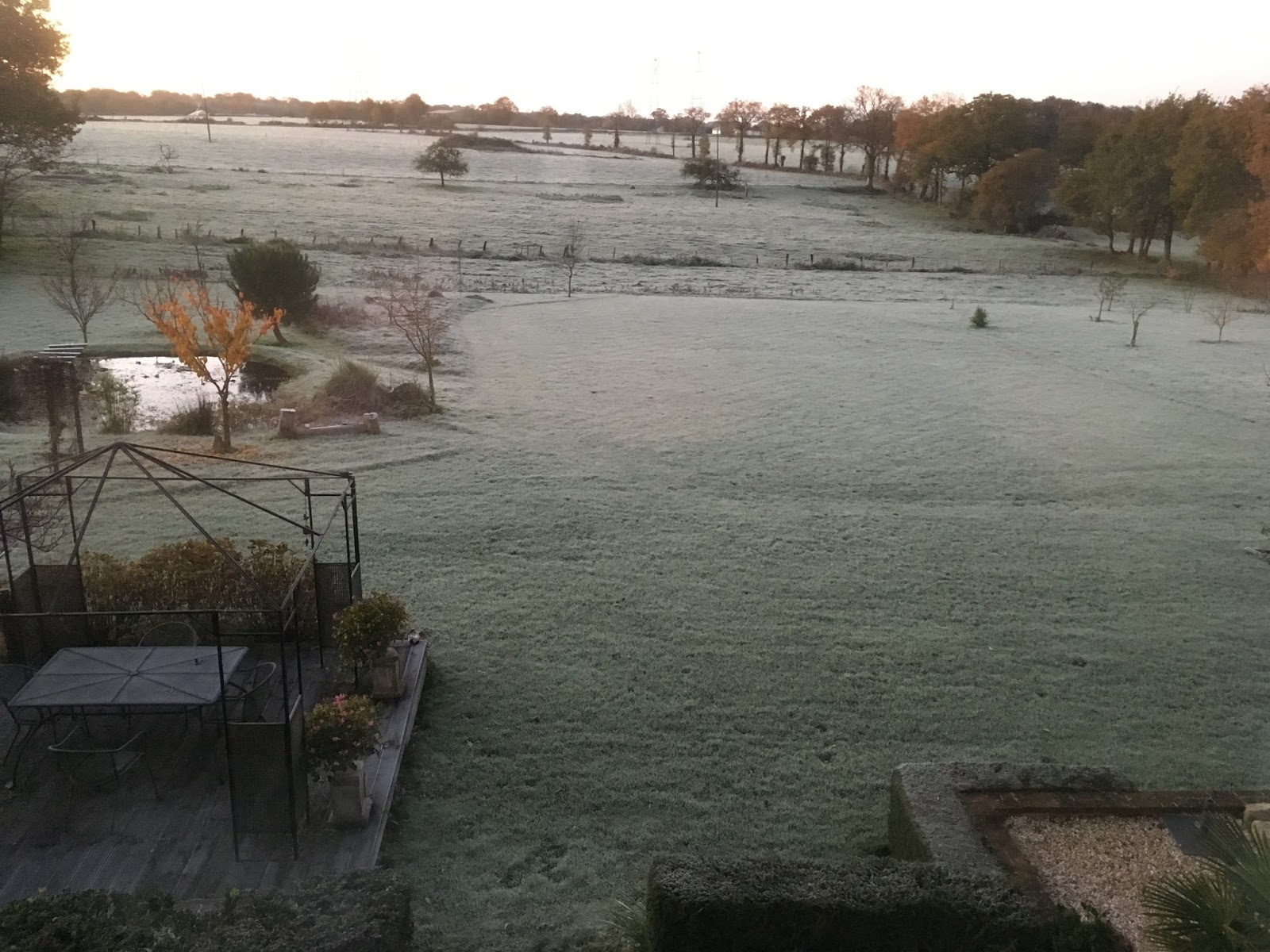
The temperature at La Basse Cour is usually a couple of degrees warmer than the south of England, but that doesn't mean we don't get frosts. At the weekend we had the first real hard frost of the year:


Gérard has been telling me since September it is going to be a hard winter starting by getting very cold at the end of November. Since he spends all his working week on a roof exposed to the elements he has an interest in these things. 

Despite my scepticism he has proved accurate so far ....

Wednesday, 22 November 2017

Autumn Colours

The seasons run a little later here than our previous home in the south of England and in other years the leaves on our trees have hung on until December then gone brown and fallen off. This year the autumn has been much brighter, maybe it's the dry year we've had (our spring has been dry since May).

Here are a few shots from around the grounds taken this week:

The ornamental cherries beginning to lose their leaves

Last burst of colour for another of our cherries

The mixed beech hedge planted in 2011 well established now

Actually over the road from us but a beautiful silver birch in Lucien's former garden

Our newly named "Sulphur Oak'

Tuesday, 7 November 2017

Contrasting Emotions of Victory and Defeat - A Psychoanalytic Approach


This article reproduces part of my dissertation research project for an MA in Management and Organisational Dynamics at Essex University
~~~~~~~~~~~~~~~~~~~~~~~~~~~~~~~~


Players in a sports team can derive much joy from victory. It gives a real sense of satisfaction that all the personal sacrifice has been worthwhile and provides a cathartic release from the fear of failure, shame and humiliation. Equally, defeat can cast a shadow of gloom and despair over the participants for days, weeks, sometimes years or the rest of their career. In spectator sports these emotions also extend to the vicarious participants, the sporting fans.


"Some people think football is a matter of
 life and death. I don't like that attitude. 
I can assure them it is much more serious than that" [1]

Why do people play sport and thus willingly expose themselves to the risk of these extreme opposing emotions? This question can only be answered by understanding how participants deal with the uncertainty of success and the unpredictability of failure, the very essence and attraction of sport.

I have played in, coached and watched competitive team sport for over forty years. I have observed teams who appeared invincible and who played with belief, skill, stamina and trust in their teammates to overcome the opposition. Equally, I have seen teams where players seemed openly to question their desire to be on the pitch, where the normal behaviour was aggression, team members distrusted each other and defeat was the inevitable outcome of stepping onto the pitch. Often, confusingly, one emotional extreme was followed a week later by the opposite with the same team and participants. As Lionel Stapley states in the title of his book “It’s an emotional game” (2002).


The conventional view holds that teams are happiest and most fulfilled in the elation of victory and most desolate in the reality of defeat. Yet there is also a value placed on the importance of being a ‘good loser’ and playing a fair game according to the rules. This Corinthian ideal, rooted in the British education system, assumed that sport could teach, on the playing field, virtues complementary to those learnt in the classroom - team spirit, fair play, bravery, pluck, swiftness of judgment, deference to arbitration, attention to detail and mastery of rules (Fernández-Armesto, 2009). In contrast to these desirable qualities, there are examples of teams or individuals who are viewed as bad winners and seen as arrogant, triumphant, narcissistic, mean or cruel in their victories.


Victory and Defeat - The Contrasting Emotions


I found little research in this area, where it exists it is found within the separate areas of sports psychology and psychoanalytic consideration of sportspeople undertaking individual sports such as golf, swimming or athletics. Many sports teams actively utilise a sports psychologist to assist them in preparing for, and responding to, competitive engagement. In the field of research, the focus of sports psychology appears to rest largely on motivation, preparation for competition and managing the subsequent response to results. These psychological techniques rely on visualisation and cognitive approaches and frequently address the issue of athlete arousal (in this application arousal refers to the intensity of involvement in the activity). They do not, however, appear to consider the source or cause of anxieties or how the  environment contributes to the reaction of the athlete.

The former test cricketer and Endland captain Mike Brearley (who qualified as a psychoanalyst on his retirement from cricket) is one of those who considered how psychoanalysis  could contribute to understanding how sports teams operate. I found that sources on psychoanalytic considerations in sport are mainly concerned with individual sports such as athletics, golf and tennis. In his book It’s an Emotional Game, Lionel Stapley (2002) wrote about his experiences from three years consulting to a manager of a professional football team in the English Football League. Stapley’s work included a psychoanalytic analysis of stress and considered the effect of anxiety on performance. One of the most compelling contributions has been made by John-Henry Carter who reflected on his experiences of playing rugby union as a professional player, his retirement and subsequent return to competitive play. Carter explicitly thought about issues of victory and defeat in team sport from the perspective of a player who was, at the time, a trainee psychoanalyst. It was immersion research; drawing conclusions from personal, direct experience and living within the day-to-day reality of a sports team. 

I differentiate psychology, which focusses primarily on psychological considerations of the individual, and the distinctly separate method of psychodynamically interpreting the behaviours of sports teams by understanding hidden subconscious feelings and beliefs of individuals and how, in turn, these influence their teammates and the team’s performance. 

In 1992, Daniel Begel, a specialist in sports psychiatry, reviewed team sports in his field and commented on the lack of relevant work. He observed that, “consulting work with athletic teams, whose primary mission is to win, needs to be reported on and understood in the context of … group therapy”. Begel was writing twenty-five years ago and it appears that there have been only limited contributions in the intervening period. 

It was this gap in the field of knowledge that I decided to investigate.

[1] Quote attributed to Bill Shankley, OBE, manager of Liverpool FC between 1959 and 1974.

Saturday, 4 November 2017

A Sabbatical from ......

This is the 300th time I've sat down to post in this blog ...... 


For the past thirteen months my twitter account has described me as "On an academic sabbatical at Essex University studying an MA".

The Chambers Dictionary defines a sabbatical as "relating to, or resembling, the Sabbath; enjoying or bringing rest; on or relating to leave from one's work (as in sabbatical leave, sabbatical visit, etc). --- n a period of leave from one's work, esp for teachers and lecturers, also esp to undertake a separate or related project."

I hadn't reflected on the derivation of sabbatical from the word Sabbath, certainly my year didn't involve a lot of rest and I wasn't on leave from my work in any very meaningful way. Although many of the teachers or lecturers I know would value a period of leave from one's work, I don't know of any who have actually taken one. Chambers hits the target in the last clause, however, I certainly was undertaking a separate project.

After six years living in France, primarily working with my hands although applying my mind in a very different way to what I was used to, I felt ready for a change and a return to more cerebral studies. 

Essex University was a good place to study - I had some issues with the teaching methods on my course and some of the "laissez-faire" approaches of academia drove us both crazy at times. 


I'll reflect a bit more on returning to student life after 34 years in some future blog posts but in the next few posts I'll include some parts of my final dissertation study on a psychoanalytic interpretation of victory and defeat in sporting teams.

Sunday, 11 September 2016

A good year for ...... the Butterflies

.The Spring this year was mainly cool and damp, it wasn't until June that we really got any warm Summer weather. Not good weather for Butterflies to hatch, grow as caterpillars, pupate and hatch.

Since mid June we've had hardly any rain and it's been warm and frequently hot, the garden flowers have been spectacular (at least where we have managed to irrigate with water from the well). Perfect weather and conditions for Butterflies. And we've been rewarded with a spectacular show beautifully recorded in Barbara's photographs.

Not usually found in the British Isles this is a Map, second brood. An interesting insect as the first brood has completely different colours and markings. (On Dahlia)


A perfect Red Admiral (on Dahlia)


The Peacock has been seen frequently but is a difficult subject to capture (On Aster)


My favourite, the Comma. I love the beautifully sculpted wings. (On Lavender)


A stunning picture of a newly hatched second brood Swallowtail. (On Verbena)


A slightly damaged Swallowtail was around the garden for a week and a half - missing an eye! (on Verbena)


New sighting this year - a Painted Lady. This remarkable butterfly migrates to Africa in the Autumn covering 150km a day and overwinters in Morocco and Mali. (On Lavender)


A Holly Blue (on Aster)

Friday, 10 June 2016

The car knows better ....

There are, I once read somewhere, 89 (or maybe it was 106, I forget now) computers on our eight year old Honda. One of them runs a piece of software called TSA and for eight years and 112,000 miles it's done ...... absolutely nothing at all apart from monitor and check and keep an electronic eye on things.

Then, as I gingerly pulled the caravan past a lorry on the A10 Autoroute heading towards Bordeaux a combination of crosswinds and an unstable air flow around the front of the truck caused the caravan to begin to snake alarmingly behind us. It was the most extreme snaking I'd ever experienced and as I reacted in the standard way (foot off the accelerator, damp out the swings with gentle steering) TSA checked whether the car or the caravan was causing the swaying, analysed if it was getting worse, decided it was dangerous, concluded my driving wasn't up to it and something much more significant needed to be done. It engaged the four-wheel drive and began dramatically applying the brakes individually to counteract the snaking, in a couple of seconds things were back to normal. The truck driver spotted the problem and slowed down to let me back across and onto the safety of the hard shoulder (at the noise of the brakes coming on and off we said "Tyre's blown out" to each other at exactly the same time). It hadn't and so after 30 seconds to collect ourselves we headed on again.


TSA has gone back to monitoring, watching and doing nothing until it's needed (hopefully it won't ever get to that again). 

It's a rather strange feeling when your car decides it's a better driver than you are and takes control away from you. In fact distinctly unsettling in hindsight but maybe another reason to buy Honda again ..... 

Aiming to get the CRV past 200,000 miles first before that time comes though.

Wednesday, 13 April 2016

View From the Trees

I reported last summer when a fully leafed big bough came down from our big oak right on an area we had been working in the previous week. "Sudden Oak Drop" is the British name for this, in French it's "Une Rupture Estivale" - which sounds both painful and threatening. The fall left a big jagged tear where the branch broke and highlighted the amount of dead wood in the tree canopy so we added this to our mental list of winter tree work. At Claudette's fête last year we had met Aymeric who had recently qualified and set up his own business as a élagueur - a tree surgeon.

There are lots of trees, mostly oaks, on the field boundaries here and late December and January are the times that the farmers maintain them. Tree maintenance French style is rather brutal, the farmers work from a platform mounted on the forks of their tractor and the trees are, if they are lucky, pollarded or, if unlucky, shaved back to a single stem with a comical small bunch of leaf growth left at the top (colloquially known as a sap puller). As with many things in France it makes sense if you know the background to how wood rights worked 200 years ago. The land owner had the rights to the trees and the major branches, the tenants to the forest of thin epicormic growth that the trees sent out in desperation believing that their last days had come (these were cut, bundled together into faggots (fagots in French)).
Real tree surgeons who climb in France are rather rare and often prohibitively expensive - both times previously we had used ex-pats working over here - and so we jumped at the chance to engage someone who lived 500m away from us. I had undertaken to handle the wood once it was cut down so Aymeric could concentrate on the aerial work but, as always, underestimated the mass of timber that comes out of a tree that is being pruned, repaired and crown-lifted. We soon found our élagueur  was a fast worker and quick climber - here he is working in the tall oak that had suffered its rupture estivale: 


And, in this picture, the size and scale of the tree are apparent as Aymeric works at the top.


Our tree surgeon also took some pictures of our property from his lofty perch:


Photo credit Aymeric MARTIN, EURL Les Jardins Suspendus

Back on the ground we took eight days to process the timber that came down in a day and a half of our fast working élagueur.


Thursday, 24 March 2016

Not another Sunset

No, it's not.

This time it's a sunrise taken over the Potager:


One of the great things about walking or cycling at the same time every day as we do is that the seasons unfold around you. So in December and January it's dark when we go out and still dark when we get back; February means dark out, light by the time we get back (and a spectacular sunrise over the ridge if we are lucky) but by March it's light when we go out and by the end of the month the sun is up before we go out.

Took this picture on Wednesday as we were leaving.

Tuesday, 8 March 2016

A fitting tribute after 80 years


On the end wall of our barn hang three watercolour impressions of French scenes, two are of Caen in Normandy and the other is the Place d'Armes in Calais. They are accurate, well-rendered and warm pictures. Not outstanding art perhaps but very competently painted.

The 1931 painting of Caen Cathedral (which was entirely destroyed during Operation Overlord after the D-Day landings) was bought by a young Barbara at a jumble sale for 2s 6d, the other two I purchased at auction in 2008 for Barbara's birthday.

They were painted by a British artist from North Shields near Newcastle called Victor Noble Rainbird and I've been interested in his life and work since I first came across his pictures. He was a prolific artist and lots of people in his local area seem to have a "Rainbird" on the wall.


Impression Caen 1931 - Victor Noble Rainbird
Hanging at La Basse Cour


Rainbird was talented artist before the Great War and joined up and served in the Northumberland Fusiliers, there's an excellent article about his war service produced by Tyne and Wear Museums at this link.

After the war Rainbird picked up his artistic career and his pictures were exhibited at the Laing Museum in Newcastle, the Walker in Liverpool and the RA in London. He visited Holland and, several times, France and our trio are from his French trips.

It appears that Rainbird used his paintings to pay his way through life and often seems to have produced paintings to settle bar bills or pay for his supper. He died in 1936 at the age of 49 and was buried in an unmarked grave, his estate having insufficient money for a memorial. And there his story rested for 77 years.


Impression of Caen Normandy undated - Victor Noble Rainbird
Hanging at La Basse Cour


Inspired by Rainbird's work a small group led by Dave Young set up the Friends of Victor Noble Rainbird to attempt to provide a permanent memorial to the artist at his burial place in Preston Cemetery. I made a small donation early on to this group but the breakthrough came in 2015 with a popular and successful exhibition of Rainbird's paintings at the Old Low Light Heritage centre in North Shields, donations and profits from sales of prints took the fund past the £5000 target. So, on a cold but sunny day on 8th March, 2016 - eighty years to the day after his death - the permanent memorial to Victor Noble Rainbird was unveiled with appropriate military pomp including the playing of The Last Post.


The Last Post


Chapeau Mr Young! - A good job well done.

All photos credited to Linda M. Kay


Read more here:

The Friends of Victor Noble Rainbird: http://www.victornoblerainbird.com/ 
Victor Noble Rainbird Wiki page: https://en.wikipedia.org/wiki/Victor_Noble_Rainbird
From Dark to Light, VNR exhibition at the Old Low Light: http://oldlowlight.co.uk/from-dark-to-light-victor-noble-rainbird/
More about the production of the memorial on Alison Spedding Photography's page: https://speddinga.wordpress.com/

Friday, 4 March 2016

New York - 15 of the best

..... pictures from our visit:

Ground Zero - The base of one of the Twin Towers is now a perpetual waterfall

Snow on the walkway by the Hudson River

Hot pretzels in the snow in Central Park

The entrance hall at the Metropolitan Museum of Art

View from the Empire State Building - Hudson River and the West Midtown area of Manhattan

Night view from the Empire State Building looking south to Manhattan


Cable tracery on the Brooklyn Bridge

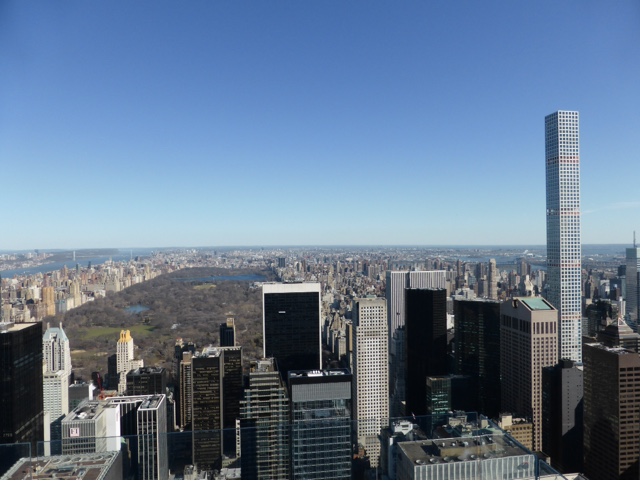
Central Park and North Manhattan from the Rockefellar Plaza Building

Adam and Charlotte at the top of the Rockefeller Plaza

Walking the HighLine path in Greenwich Village


No caption needed!

The Manhattan skyline from the water

Brooklyn and Manhattan Bridges on the East River

The atrium at Grand Central Station

Central Park Zoo


Sunday, 28 February 2016

In a New York State of Mind


I'm not really one for in-flight films, the poor sound quality, small screen and uncomfortable environment don't add to the enjoyment for me. I do like to read the paper, preferably it's a weekend flight as the volume of readable print is much bigger. The Saturday Daily Telegraph used to be good for about 6 hours on the flight to Tokyo (now with it's advertising pull-outs and shrinking news content I doubt it would get past a trip to Athens .....).

So newspapers and music work best for me.

On a recent trip to New York - on a Sunday - I thought it would be a good idea to put together a New York playlist of songs and so as the BA 747-400 rolled down the runway on takeoff I had the opening jazz chords of Billy Joel's New York State of Mind for company.


Other songs on the playlist included:

An Englishman in New York - Sting
First we take Manhattan - Leonard Cohen
Bleeker Street - Simon and Garfunkel
New York, New York - Gerard Kenney
Fairytale of New York - Pogues/ Kirsty McColl
Downtown - Petula Clark
Ellis Island - Mary Black
Honky Tonk Women - Rolling Stones
Leaving New York -REM


Now, here's the strange thing. During the week I repeatedly found myself somewhere in a song title or lyric from my youth. Plenty of Simon and Garfunkel of course (they came from Queens - just over the Brooklyn River) but other stuff as well. In no particular order:

Bleecker Street (Passing through Bleecker Street on the subway)
59th Street Bridge Song (walking along 59th Street at the bottom of Central Park)
At the Zoo (taking the subway to the Zoo in Central Park)
The Boxer (walking up 7th Avenue - listen to the Lyrics)

Image result for simon and garfunkel


It was also a pleasure to mentally re-acquaint myself with the music of Steve Forbert whilst standing in the amazing architectural space of Grand Central Station: Steve Forbert - "Grand Central Station, March 18, 1977


Image result for steve forbert grand central station


I could go on and on; during the week songs from Bruce Springsteen, Leonard Bernstein, The Ramones, Suzanne Vega, Lou Reid, George Gershwin all crossed my path.

Remarkable how one city has inspired so much creative energy.